

Nearly three quarters of accountancy firms are now turning away clients because they are short-staffed, according to a global survey from Advancetrack. Despite falling employment rates, and job cuts at the industry’s largest players mean there is actually a rising level of available talent, many are finding that it is becoming difficult to attract new hires, thanks to the industry’s famously intense workload.



The global accounting sector finds itself at a crossroads. While much recent discourse in the industry has centred on the hype around AI, and its apparent potential to take on junior work at firms – many organisations actually feel they are enduring a shortage of human talent.
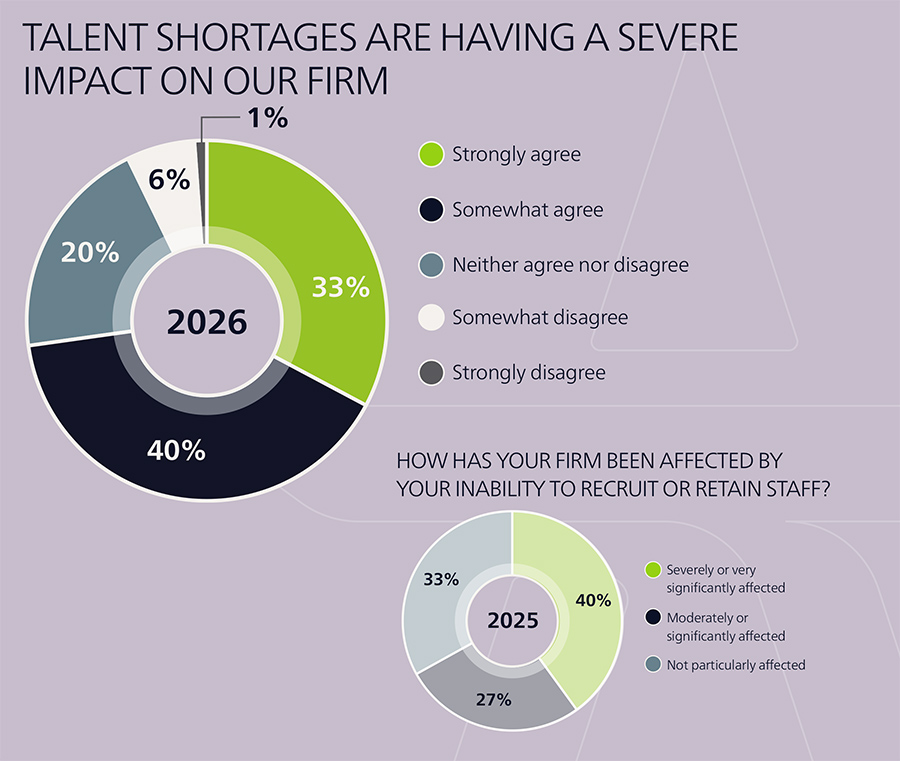
Outsourcing specialist Advancetrack has released the 2026 Accounting Talent Index – a global survey of accountancy leaders, which shows the scale of the ongoing recruitment challenge facing the industry. Speaking to some 500 respondents, the survey found that 73% of firms claimed to be “turning away potential clients” due to a lack of available staff. On top of this, the same proportion described the impact of a perceived “talent shortage” on their business as “severe”.
Source: Advancetrack
Previous editions of Advancetrack’s Accounting Talent Index have highlighted an apparently growing skills shortage. However, the 2026 are the first time it believes the issue “has now escalated into a direct constraint on firms’ ability to deliver work and generate growth.” And the firm’s data suggests the issue is not easing. A total of 45% of respondents said the talent shortage is worse than three years ago, including 19% who believe it has worsened significantly.
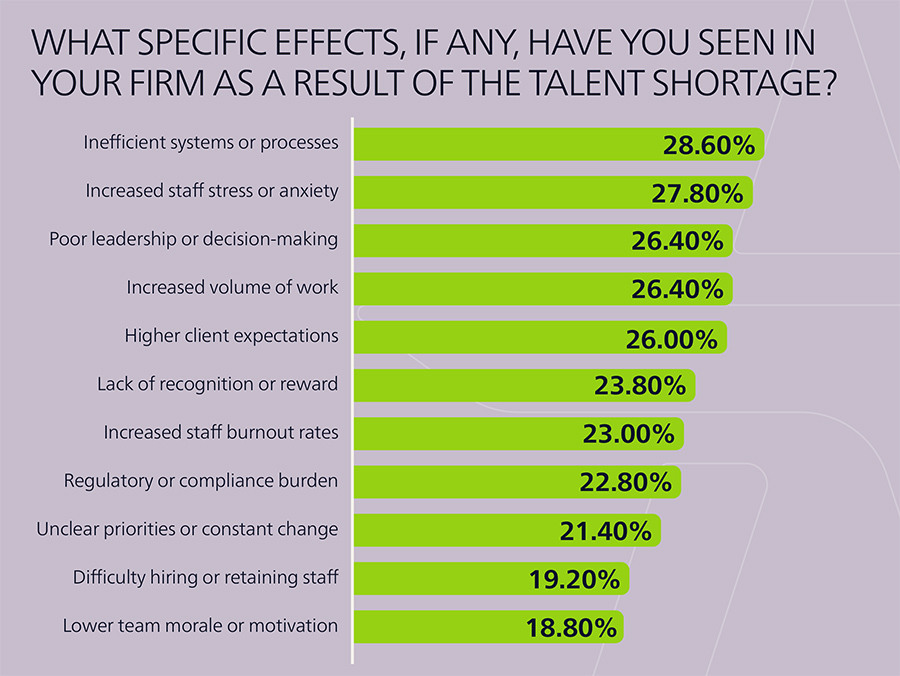
Among the specific impacts, the most common was that systems or processes in the organisation have become less efficient – cited by 28% of respondents. This was followed by 27% noting increased staff stress or anxiety – and as well as a symptom, this may well be a source of the problem. One which threatens to compound the situation further in the coming years.
Retention issues
The thing is, if the press around the supposed AI apocalypse wiping out graduate roles is to be believed, alongside the Big Four freezing hiring and clearing out parts of their headcount – and broader unemployment now on the rise – there should be a growing pool of immediately relevant, or trainable talent available to accounting firms. And yet many of them say there is somehow nobody available with the relevant skills to fill their vacant roles.
Source: Advancetrack
When quizzed on this conundrum, Vipul Sheth, managing director of Advancetrack, noted that accounting firms may be seeing a number of factors come to a head. Most notably, the Accounting Talent Index found that 74% of firms believe sustained workloads “could push people out of the profession”, while more than a quarter of respondents said “they had personally considered leaving altogether”. That means that even while competition for talent may be slowing in some areas, “many firms are still struggling to retain experienced people and maintain enough capacity to meet demand.”
Sheth added, “What firms need now is changing quite quickly. There’s still strong demand for people with technical expertise, commercial judgement and client-facing skills, particularly as regulation and expectations become more complex. One of the more interesting things from the research is that firms are investing in AI alongside training, development and wellbeing support. That suggests most see technology as something that changes or enhances how their teams work, rather than removing the need for good people altogether.
“My personal view is there’s also a broader mindset shift happening around AI which is worth recognising. Some firms will inevitably look at it through a cost and efficiency lens, particularly in areas where repetitive work can be automated. But many others are focused on how technology can help their existing teams deliver more value, improve quality, reduce burnout, and free up time for higher-level advisory and client work. In practice, the firms gaining the most from AI are often the ones treating it as an enabler for their people rather than simply a replacement for them. That’s why investment in training, adaptability and human skills remains so important alongside the technology itself.”
Source link
#Threeinfour #accounting #firms #struggle #work #hiring #challenges