



There isn’t a single watershed year in the history of the Hollywood Western, but if you’re looking for a moment where moviegoers could sense that the white hat/black hat era was swiftly drawing to a close, 1962 featured two elegiac oaters starring gunslinging legends who were nearing the end of the trail.
The most prominent of the pair was John Ford’s “The Man Who Shot Liberty Valance,” which brought together big-screen icons John Wayne and James Stewart, for the first time, as two very different kinds of men without whom the West would’ve surely collapsed into lawlessness. The narrative is built around Stewart’s Ransom “Ranse” Stoddard, a U.S. Senator who endangers his chance to become the next Vice President by telling a journalist the truth about his well-publicized killing of the outlaw Liberty Valance (Lee Marvin). The public views Ranse as a hero, but in reality he was a civilized man who couldn’t best Valance in a gunfight. We eventually learn that Ranse’s friend, rancher Tom Doniphan (Wayne), knew this, and saved the future statesman by shooting Valance from a distance. The journalist could destroy Ranse’s career with the exclusive he’s been gifted, but he chooses instead to sit on it. “When the legend becomes fact, print the legend,” he says. Ain’t that America.
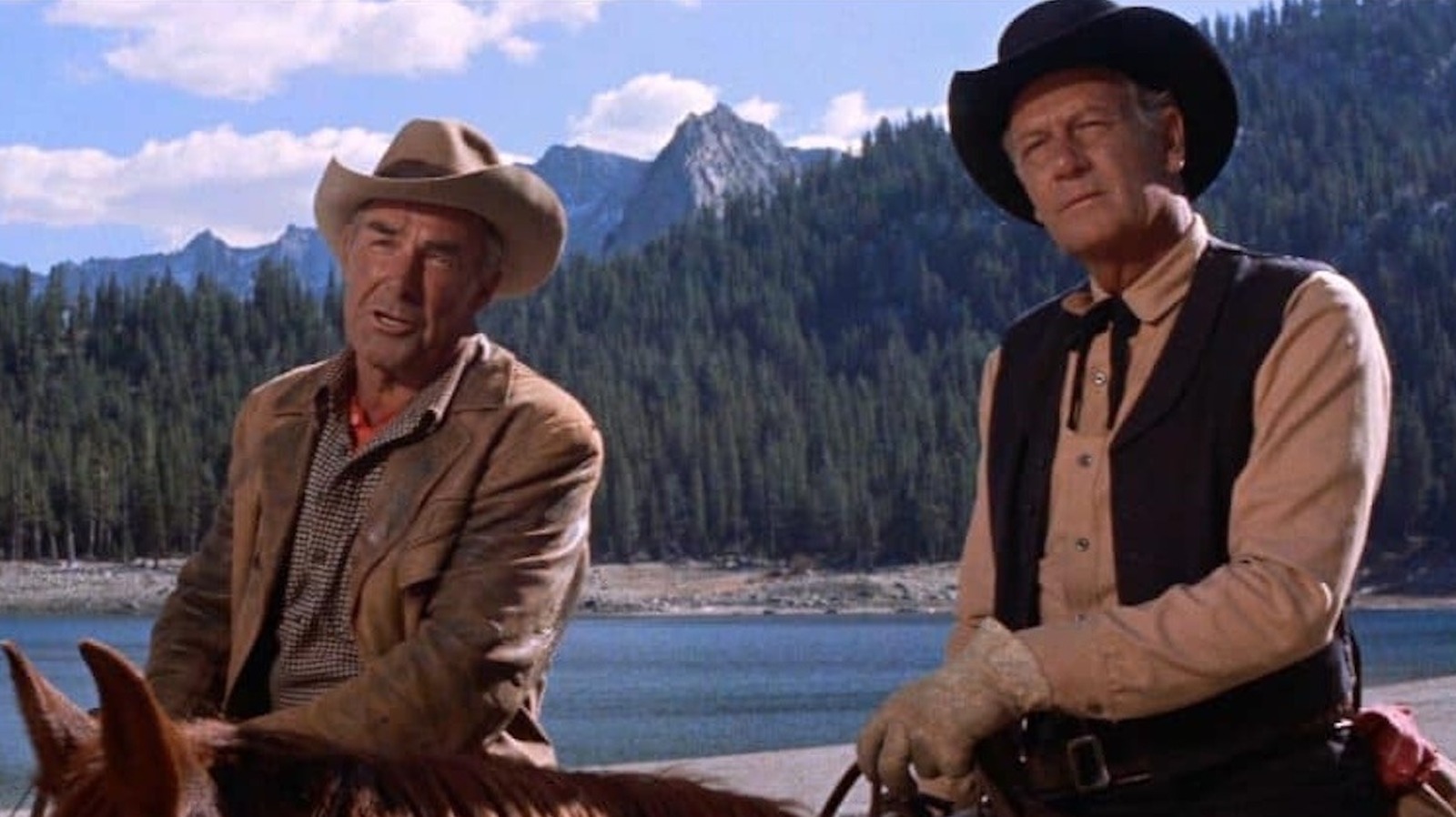
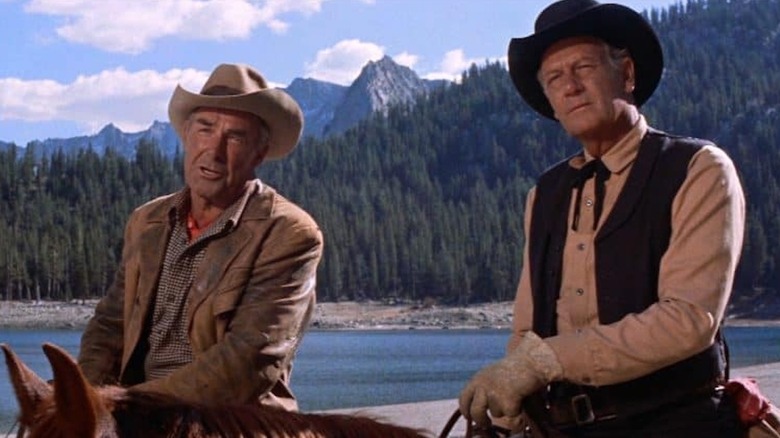
Sam Peckinpah’s “Ride the High Country” wasn’t as overt as “The Man Who Shot Liberty Valance.” It sets up as a straightforward programmer about two former lawmen, Gil Westrum (Randolph Scott) and Steve Judd (Joel McCrea), who, in need of money, agree to escort a gold shipment through outlaw-ridden territory. But while it’s familiar in form, Peckinpah gets clever with the content. And with its first-time teaming of two aging stars, the film hits some of the same melancholy notes as Ford’s classic.
Randolph Scott and Joel McCrea gave the Golden Age Western a moving send-off in Ride the High Country
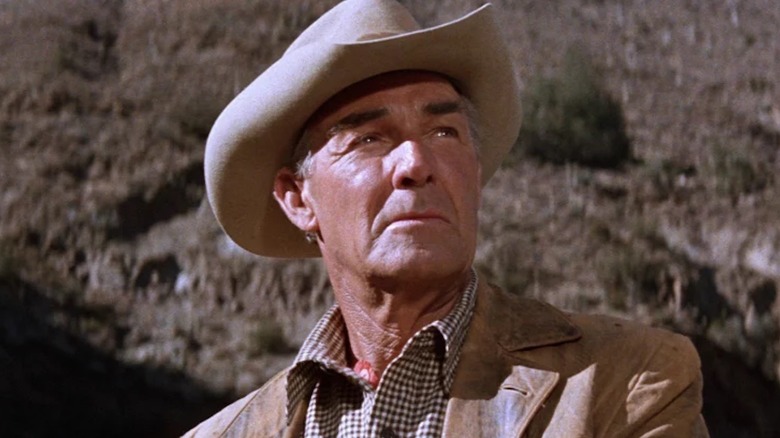
In 1962, the only star more synonymous with Westerns than Randolph Scott was John Wayne. But unlike the Duke, Scott was a versatile performer who was equally at home in musicals and screwball comedies. It just so happened that the public grew to love seeing him brandish a rifle astride a horse, so that’s where Hollywood put him — and where he toplined a series of masterfully directed films with director Budd Boetticher.
Joel McCrea was primarily a Western star in 1962 as well, but because he retired from acting when I was three years old, I knew nothing of his work until I watched Preston Sturges’ screwball masterpiece “Sullivan’s Travels” as a teenager (on Steve Martin’s advice in “Grand Canyon”). After howling through that movie (until it turns somber in the third act), I was determined to watch more Sturges movies, which led to more McCrea (in “The Palm Beach Story” and “The Great Moment”). Then I saw him in Alfred Hitchcock’s “Foreign Correspondent,” at which point I viewed the star as an urbane, witty, stylish gentleman.
McCrea was exceptional in these roles, but as he neared his 50s he didn’t want to play on-the-make bachelors anymore. If he was to continue on as a movie star, he’d do it in Westerns, where he wouldn’t be expected to romance a considerably younger woman (a prospect that drove McCrea’s contemporary, Cary Grant, into voluntary retirement).
Much like their characters, Scott and McCrea wanted different things out of “Ride the High Country.” Knowing where their careers went after the film’s release, it joins “Junior Bonner” and “The Ballad of Cable Hogue” as one of the few Peckinpah works that can legitimately be called poignant.
The new Western would be no country for white hats
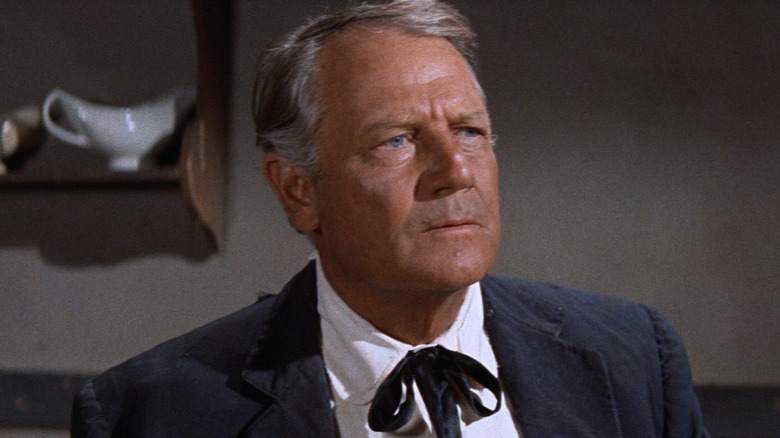
Randolph Scott turned 64 in 1962, but unlike the hard-drinking, heavy-smoking John Wayne, he took care of himself. “Ride the High Country” didn’t have to be his last movie, but Scott had supplemented his film success with astute investments. He was wealthy and ready to bid the rigors of filmmaking a well-earned adios. As such, he brings a little extra weight and a hint of resignation to his performance. Gil’s savvy, and knows the pay for protecting the gold shipment — if he survives to actually get paid — won’t last long. So, he plans to steal the gold. The perceptive Judd sniffs this scheme out early, which keeps everyone, particularly the audience, on their toes throughout.
Judd simply isn’t the type to break bad, which might be a source of strength in Western movies, but it tended to leave you at the mercy of bad men in the actual Old West. This conundrum gets directly confronted at the climax of “Ride the High Country.” I won’t spoil what happens other than to say that Scott’s final moment in front of a movie camera represents some of the best acting he’s ever done. The same goes for Joel McCrea, who never got a decent piece of material after this. For this reason, McCrea’s post-1962 career doesn’t exist for me. As far as I’m concerned, they both rode out together high in the saddle
As for Peckinpah, this was a beginning. The same was true for the film industry. The old guard of Hollywood’s Golden Age was getting nudged aside by hungry young actors and filmmakers eager to reckon with an increasingly fractious sociopolitical era. Moral ambiguity would be integral to the New Hollywood movement. Maybe 1962 was that watershed year after all.
Source link
#Western #Classic #Time #Hollywood #Legends #Worked #SlashFilm




