New Delhi:

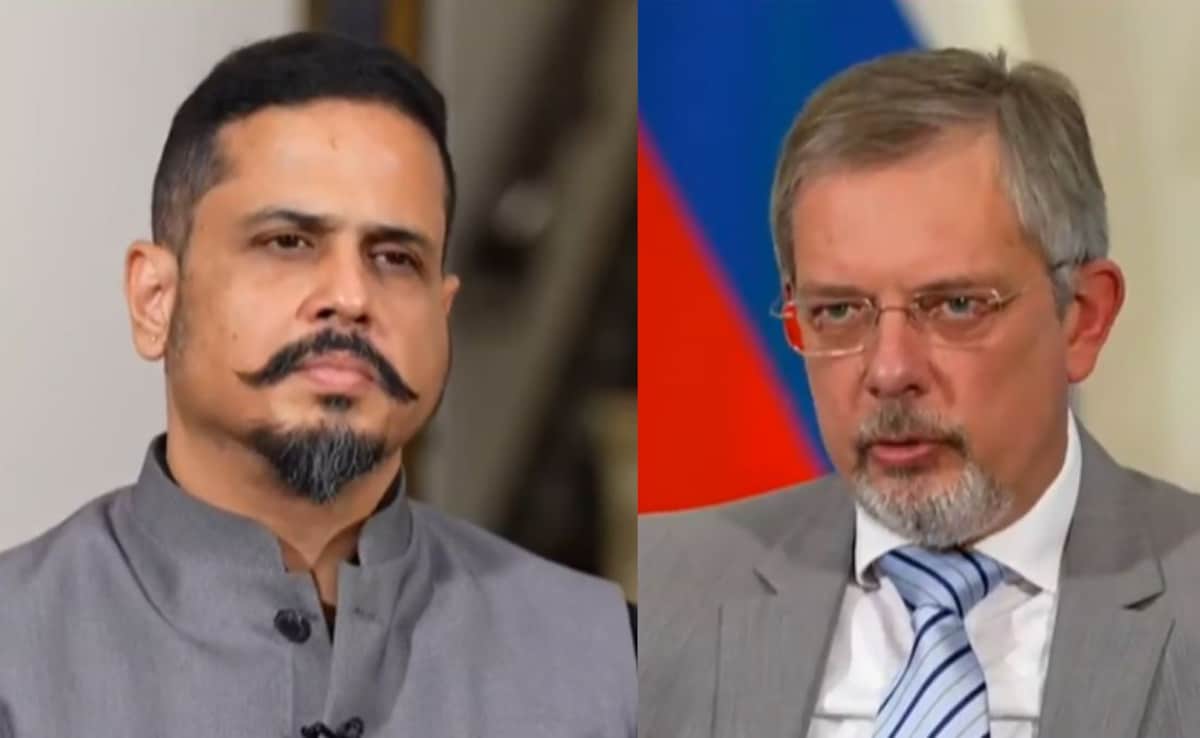
The relationship between India and Russia has remained steady through “huge geopolitical churn” and has continued to make progress on multiple fronts despite conflicts elsewhere in the world, the Russian ambassador to India has said.
In a wide-ranging interview with NDTV’s Shiv Aroor, Ambassador Denis Alipov described the bilateral relationship as “very consistent” and “comprehensive in nature”.
“I’ve been dealing with the Russia-India relationship throughout my career, and it’s been a very rewarding time. The relations between our countries have been very consistent. They are comprehensive in nature. We steadily progress on many tracks. We’ve been having very robust cooperation and defence in energy. We increase our interactions in culture and expand on the economic track. The contacts between the leaders have been regular and very intense. The political contacts between us have been very intensive, have always been very intensive,” Alipov said.
The Russian Ambassador added that Moscow and New Delhi also coordinated closely on international issues beyond their bilateral ties.
“Both Russia and India play a very active role in international politics on issues that are not directly related to our bilateral relations, but on issues and conflicts that have been and are a feature of the times, so to say. The Middle East, the Gulf War is very indicative in this sense. So we do engage a lot, we coordinate, and both the Russian government and the Indian government stand for stability, for dialogue, and for peace in the world. This is something that should be endorsed by all,” he said.
The Middle East War
On Russia’s assessment of the Gulf conflict, which has involved US and Israeli actions against Iran, and which he described as having “very severe” implications for the world, Alipov said no one could not predict exactly how events would develop, but added: “Most likely the US itself does not see and foresee the developments. But the implications have obviously been very severe for the whole world. I guess the Gulf countries have become disillusioned with the US and the security guarantees that were promised to them. Obviously, the US has failed in that. The actions have been very erratic. Generally, the dominant position of the US has been undermined by the US itself.”
Iran’s Revolutionary Guards on Tuesday threatened to end oil production in the Middle East if the Islamic Republic faced attacks launched from its Gulf neighbours’ territory. The US
Before a two-week ceasefire between the United States and Iran took effect, the UAE had borne the brunt of Tehran’s attacks, weathering more Iranian strikes than any other country, though most were intercepted.
“The economic impact is also very severe. The energy markets and the fertiliser markets have been jeopardised. And this instability, I believe, will be very difficult to overcome, and it will continue for at least several years,” Alipov told NDTV.
US Actions Against Iran
The Russian Ambassador added that many rightly speak about the damage to civilian infrastructure in the Gulf states, but very few speak about the same that has been done against Iran.
“I see very few reports about such atrocities as the bombing and the killing of 130 schoolgirls in Iran. These aspects have to be addressed and have to be highlighted,” he said.
According to Alipov’s assessment, this is the “expression of the desire” of the US and also the European Union, the “so-called Euro-Atlantic community”, to retain the “dominant” position in politics and in global economy.
“The same actions we have seen against us in Ukraine, and it’s being done now in the Gulf. We should not forget the US actions against Venezuela, the desire to control the energy markets, the oil flow on a global scale. I think this is something that we now see, and this is what lies beneath the actions undertaken in the Gulf against Iran,” Alipov said.
Alipov added that all the actions should be condemned, including “the killing of the members of the legitimate government of Iran” and “the attack on Iran per se”. He stated that Russia stood “against any civilian targeting” but added that Iran’s retaliation “could have been predicted” and that there should have been stronger opposition to US intentions.
“Iran has withstood. It defends itself now in negotiations that I believe are ongoing or will resume. There have been direct contacts between the US and Iran. The peaceful resolution, the negotiations are obviously the only way to achieve a compromise. And from what we see, Iran is prepared for compromise, although it has been the target in this war. But it is prepared to compromise. It is prepared to compromise on this very important question of its own nuclear industry development. And hopefully some kind of a formula will be found and the negotiations would lead to the cessation of hostilities and the stabilising of the situation,” he said.
When asked whether a formula could be found, particularly on the nuclear issue and the Strait of Hormuz, Alipov replied: “There is always a way out. And the way out should be through the negotiations. They can continue fighting, but it would only aggravate the situation. Iran, from what we know and see, is prepared to compromise. So it is more a question for the US whether the US is prepared to compromise, to abandon its maximalist position, which may well be now. The situation, I believe, would stabilise, but the big question is when this will happen. But the implications will last for some time.”
He noted that the conflict had already prompted countries such as India to diversify energy and fertiliser supplies, describing this as “one implication that will last and one of the results of this adventure the US has initiated”.
Russian Oil Supply
On Russian oil supplies to India, which have increased during the conflict, Alipov said: “Our oil supplies have substantially increased. India is buying a lot of Russian oil recently. It was buying our oil before the Gulf War and we would like to sustain this level of cooperation in energy.”
He described US and EU sanctions on Russia as “illegal in nature” and said India did not recognise them.
“These are the instruments the US uses, the European Union uses for their benefit as a means of pressure, not only pressure against us but also as a way to pressure other countries which have nothing to do either with the Ukrainian crisis or the Gulf crisis. But these countries have been severely affected. India has been severely affected. Such instruments should be discarded outright,” he said.
“We have always stated that we are prepared to supply as much oil as India is prepared to absorb. In the current situation, this relationship in oil supplies has been very helpful to India,” Alipov added.
Putin In India
Turning to future high-level contacts, Alipov confirmed that Russian President Vladimir Putin was expected to attend the BRICS Summit in India in September, where India holds the chair. He said bilateral meetings between President Putin and Prime Minister Narendra Modi were likely, and that India had been invited to hold its annual summit in Russia later this year.
The two leaders, he said, “have been very open to each other. There are no forbidden topics in the discussion. They have known each other very well. They have this personal touch between them, a personal formula. Such meetings have always been very productive. The results have been forward-looking. We have a comprehensive strategic programme in economic relations until 2030. We have agreed to increase the volumes of bilateral trade. We know how to do that. Defence obviously is on top of the agenda. We look forward to President Putin’s visit to India this year.”
On the defence relationship, Alipov expressed satisfaction with the performance of Russian-supplied weapons used by India, including the S-400 system. He confirmed that discussions continued on possible cooperation on the Su-57 5th-generation fighter aircraft.
“Su-57 is something we discuss. India has not made it public, nor has it taken any decision on the Su-57 aircraft. But we are hoping that we will have such cooperation on this particular platform, since it has been one of the most advanced aircraft in the world,” he said.
Source link
#Su57 #Jets #USIran #Vladimir #Putin #NDTV #Exclusive #Russian #Ambassador