The February 28 US-Israel attack on Iran – and the war it triggered – was widely seen as Europe’s chance to stand up to Donald Trump and maybe redefine the post-World War global order.
Most international law experts agree the war on Iran violates UN Charter rules on the use of force, and also that Washington’s unilateral actions against Venezuela, i.e., the kidnapping of President Nicolas Maduro and his wife, are illegal.
Advertisement – Scroll to continue
The Feb 28 attack was seen as Brussels’ chance to seize control of the narrative from Washington – after having been battered by tariffs, threatened with the loss of the US defence umbrella, and bullied and insulted over a perceived lack of support for the war – and infuse it with principles of non-aggression and social and economic justice, and respect for the rule of law and human rights.
Instead it has laid bare faultlines with several European nations, including its big three – France, Germany, and the UK – seen as pivoting from masked criticism to capitulation and passive support of American military operations in West Asia, including allowing their bases to be used to arm, fuel, and launch attacks.
“Cowards,” Trump posted on Truth Social March 20, targeting NATO allies, including EU members, over an earlier refusal to provide military support to secure the Strait of Hormuz.
The exception, again, was Spain.
Spain defies Trump, NATO pressures
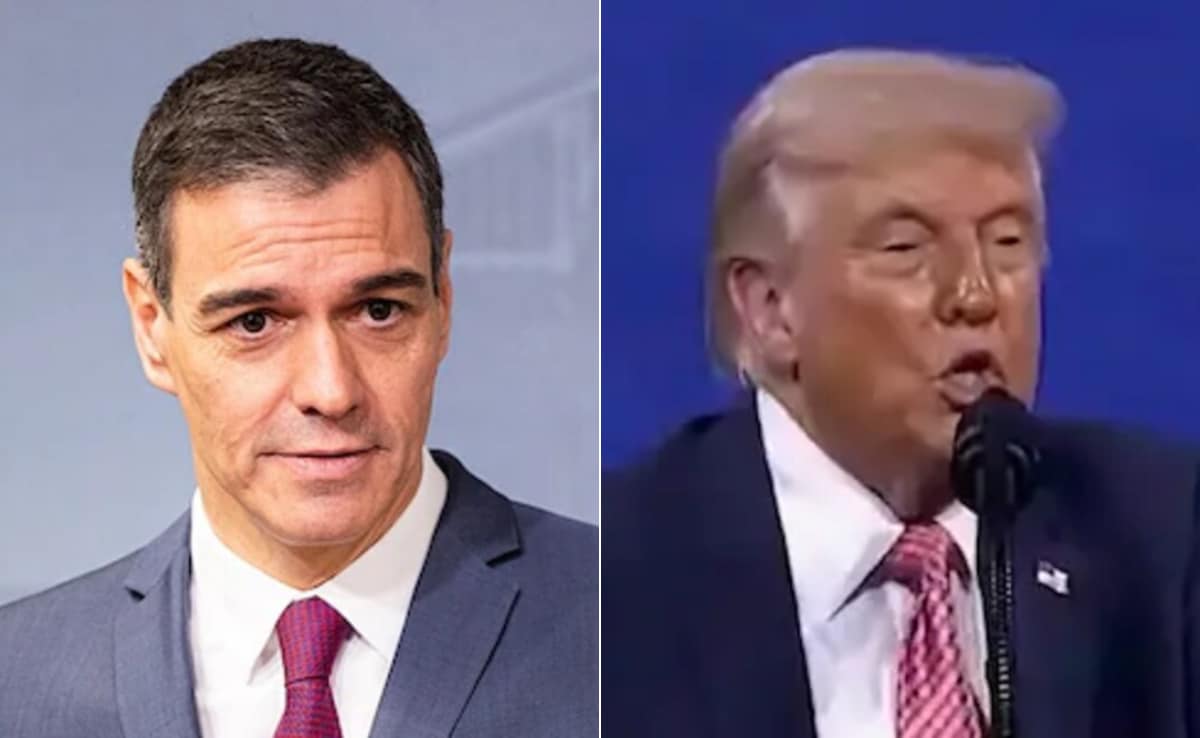
Madrid followed strong condemnation of Israel last year – Prime Minister Pedro Sanchez called for the country to be barred from international sporting events over “barbarism” in Gaza and scrapped a US$600 million rocket-launcher deal – with scathing remarks about the war in Iran.
Speaking in the Spanish parliament last week, Sanchez blasted “an illegal, absurd, cruel war that sets us back from our economic, social, and environmental goals” and underscored his government’s refusal to support the US-Israeli war as illegal and regressive.
Days earlier, in remarks widely quoted by Spanish and international media, Sanchez said, “Of course… this war is not only illegal but also inhuman”.
But the defining quote was on March 4; in televised remarks to the nation Sanchez responded to Trump’s demand to use Spanish bases to launch attacks on Iran.
“The position of the Spanish government can be summed up in four words: no to war,” he said.
Spain under the left-leaning Sanchez has emerged as a principled outlier in Europe’s position on violence in Gaza – he called Israel’s actions “genocide” – and now in Iran. Sanchez has even threatened to withdraw Spain from the FIFA Football World Cup in the US in June.
More crucially, he has maintained that stance despite threats of a full trade embargo, though Washington has been quiet since, possibly mollified by other European nations opening up.
But Trump’s “Spain has been terrible” comment underscored growing tension between the countries. Madrid’s refusal to hike NATO defence spending has also irked Trump.
Sanchez’s Italian counterpart, Giorgia Meloni, was a second anti-war voice, breaking from previous alignments with Trump to criticise US-Israel attacks as a violation of international law.
Germany, East Europe tilt toward Washington
On the other side of the spectrum, several leaders, the European Council on Foreign Relations said, had “implied that a realistic view of global politics requires a move away from fully supporting prohibition on the use of force, except for genuine self-defence”.
In the case of Germany that included remarks by Chancellor Friedrich Merz about international law having “relatively little effect” against Iran if it ignores global norms, in remarks seen as backing force when legal limits fail.
Critics quickly pointed out Berlin had been quick to condemn Russia’s war on Ukraine – which legal experts have said is as illegal as the US’ on Iran – as a violation of international law.
Belgium and the Netherlands denounced a “murderous Iranian regime”.
European Union Commissioner President Ursula von der Leyen seemed to echo that sentiment with a call “to see the world as it actually is today” and declaring: “… there should be no tears shed for the Iranian regime”.
Poland and parts of Eastern Europe – the Baltic states, Czechia, and Romania – have all broadly aligned with the US on its claim that Iran poses a threat to international stability.
EU’s collective identity fractures
Europe is sharply divided on how to view fighting in West Asia and subsequent pressure on the global energy trade, which has seen fuel and gas prices increases worldwide.
The problem, though, is that there is no unified reaction.
Europe built for itself an identity built on the idea of a collective, but that collective appears missing, or uncertain on how to deal with Trump and his war.
It underlines also a limited strategic heft, something Trump has potentially realised, judging by his bombarding its leaders with taunts and insults, and still getting his military support.
The US’ defence prowess could play a key role here. European leaders are likely aware that if Washington removes its shield that opens its eastern flank to Russia.
Source link
#Europe #Split #Trumps #Iran #War #Spain #Leads #Defiance