WASHINGTON — Pivotal negotiations in Pakistan this weekend between the United States and Iran could hinge on developments in Lebanon, where ongoing Israeli strikes Thursday risked derailing a wider regional ceasefire.
Tensions only deepened amid reports of limited Iranian drone attacks across the region, and as Arab states warned that the Strait of Hormuz — a vital global shipping route — had only partially reopened despite President Trump’s assurances that Tehran had guaranteed full access.

Yet tests of the ceasefire have not deterred Iranian and American officials from their plans to travel to Pakistan on Saturday for the highest-level talks between the two nations, aimed at a final agreement to end the war, now in its sixth week.
The stakes are high for Iran, which has been pummeled by U.S. attacks, and for Trump, whose pursuit of the war has been domestically unpopular. The plan appeared precarious early Thursday, amid ongoing disagreement over whether the ceasefire included Lebanon.
Iran warned that continued Israeli attacks targeting the militant group Hezbollah in Lebanon could jeopardize the two-day-old truce. Hours later, Israel Prime Minister Benjamin Netanyahu said his government would open direct negotiations with Lebanon — but subsequently declared he would not cease strikes there.
His move to negotiate with the Lebanese came the day after President Trump asked Netanyahu to slow operations in Lebanon ahead of the Pakistan talks, a source familiar with the matter told The Times. Iran’s Foreign Ministry spokesman, Esmail Baghaei, told reporters Thursday that the talks starting would be “contingent” upon hostilities ceasing in Lebanon.
As Israel’s posture on Lebanon injected uncertainty into the situation Thursday, the Strait of Hormuz — which Iran agreed to reopen in the ceasefire deal — remained closed, according to Sultan Al Jaber, a government minister in the United Arab Emirates. Traffic through the strait was below 10% of its usual volume Thursday, with only seven ships passing through in a 24-hour period, Reuters reported.
“Iran is doing a very poor job, dishonorable some would say, of allowing Oil to go through the Strait of Hormuz. That is not the agreement we have!” Trump wrote on social media Thursday evening.
Still, the president had projected optimism Thursday about the weekend negotiations in Islamabad — even as the U.S. position appeared to weaken.
“I spoke with Bibi and he’s going to low-key it. I just think we have to be sort of a little more low-key,” Trump said in an interview with NBC News. He said he was “very optimistic” that a deal with Iran was in reach.
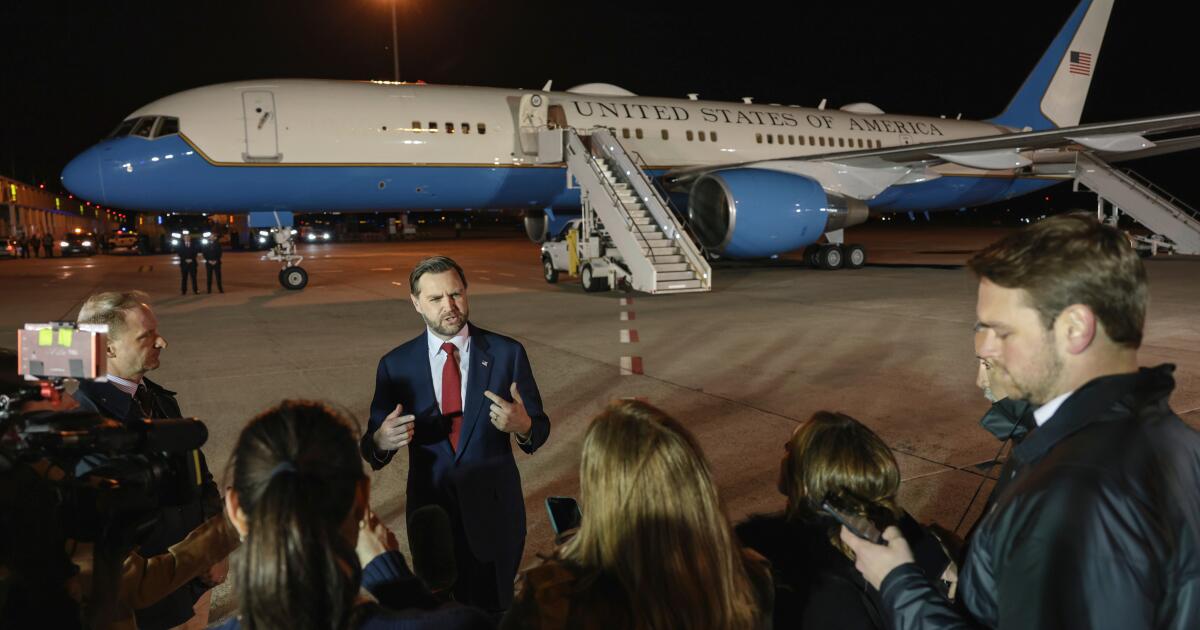
A White House official said Vice President JD Vance will lead the U.S. delegation, which will also include special envoy Steve Witkoff and Jared Kushner, the president’s son-in-law. They would be the highest-level talks between the United States and Iran since the 1979 Islamic Revolution.
An Israeli official said the separate talks with Lebanon, to be conducted by the Israeli and Lebanese ambassadors to Washington, would start next week at the State Department. A State Department official confirmed the agency would host the talks.
Israel is not a direct party to the weekend negotiations in Pakistan between the U.S. and Iran. But “the United States knows our red lines in terms of nuclear disarmament, proxies, ballistic missile production,” the Israeli official said. “We believe we’re on the same page here.”
The Tuesday night ceasefire deal between the United States and Iran came after 39 days of conflict in the region, set off by Trump’s Feb. 28 attack on Iran. The full terms have not been publicly disclosed, and much remains uncertain about the agreement.
The agreement got off to a shaky start Wednesday: The strait remained restricted as the Iranians accused Americans of violating the agreement and it emerged that the U.S. and Israel were at odds with Iran over whether Lebanon was part of the ceasefire.
Trump threatened late Wednesday on his social media website that if Iran did not comply with the ceasefire, “then the ‘Shootin’ Starts,’ bigger, and better, and stronger than anyone has ever seen before.”
The deal’s status became even more fragile as Thursday dawned and Iran said Israeli strikes in Lebanon overnight violated the agreement. European leaders and the prime minister of Pakistan, which is brokering U.S.-Iran talks, warned that the operations could be putting the truce at risk.
“This is a dangerous sign of deception and lack of commitment to potential agreements,” Iranian President Masoud Pezeshkian said Thursday. “The continuation of these actions will render negotiations meaningless.”
The speaker of Iran’s parliament, Mohammad Bagher Ghalibaf, warned of “explicit costs” for any moves Iran views as violations of the ceasefire, saying Lebanon was an “inseparable part” of the deal.
Israel and the U.S. have said that Lebanon, where Israel says it is targeting Iran-backed Hezbollah militants, was not part of the ceasefire agreement. Netanyahu said in a Thursday evening statement that he was pursuing negotiations at the request of the Lebanese government.
“There is no ceasefire in Lebanon. We are continuing to strike Hezbollah with full force, and we will not stop until we restore your security,” he said.
Also Thursday, House Republicans rebuffed an attempt by Democrats to vote on restricting Trump’s war powers. Democratic leaders — who have raised concerns about Trump’s Easter Sunday threat to wipe out Iranian civilization and said his statement amounted to threatening war crimes — afterward called on Speaker Mike Johnson (R-La.) to bring Congress back to session.
Meanwhile, Trump railed on his social media website against conservative figures who have criticized his approach to the war, including former Fox News hosts Tucker Carlson and Megyn Kelly, calling them “stupid people” and proclaiming that the United States “IS NOW THE ‘HOTTEST’ COUNTRY ANYWHERE IN THE WORLD!”
He also continued to attack NATO members for not living up to his expectations in helping him with the war in Iran. In a post earlier Thursday, the president said the North Atlantic Treaty Organization has been “very disappointing” and suggested the United States needs to pressure allies in order for them to respond to its needs.
That followed a meeting Wednesday afternoon with NATO Secretary Mark Rutte at the White House, after which Trump asserted online that “NATO WASN’T THERE WHEN WE NEEDED THEM, AND THEY WON’T BE THERE IF WE NEED THEM AGAIN.”
In an interview with CNN, Rutte said Trump had made his disappointment with NATO allies clear. Rutte said he had emphasized to Trump that a large majority of European nations have given the U.S. some logistical military help, such as allowing American warplanes to land at their bases and fly over their territories.
Lebanon’s Health Ministry said Israel’s surprise barrage of airstrikes on Wednesday killed 303 people and wounded about 1,150 others, in a preliminary toll. It added that the numbers were likely to rise while search efforts for bodies and DNA testing continue.
If direct negotiations with Israel do take place, they would break a long-standing political taboo for Lebanon. Successive governments have dealt with Israeli diplomats only as far as allowing technical discussions with Lebanese military officials via the United Nations.
The prospect of direct negotiations is likely to kick up fierce opposition from Hezbollah and its political ally, the Lebanese Shiite party Amal.
Both parties — which together form the so-called Shiite Duo, are part of a voting bloc in parliament and hold important portfolios in Lebanon’s Cabinet — are already in a war of wills with the Lebanese government, which recently declared the Iranian ambassador-designate persona non grata and ordered his departure.
Amal and Hezbollah officials told the ambassador-designate to remain in Lebanon and exhorted the government to reverse its decision. He remains at the embassy in Beirut.
McDaniel and Wilner reported from Washington and Bulos from Amman, Jordan. Times staff writer Ana Ceballos in Washington contributed to this report.
Source link
#U.S #talks #Iran #tests #ceasefire