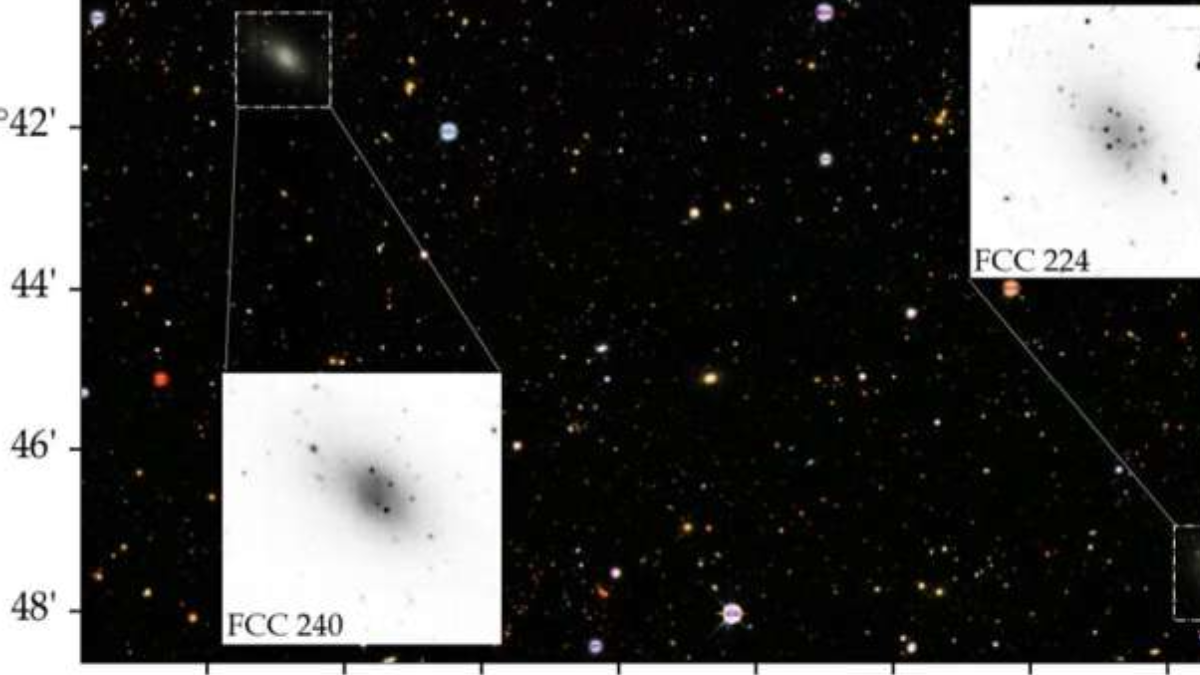
Galaxies are supposed to be kept together by dark matter, that invisible gravitational scaffold cosmologists say is essential for how they take shape and keep going. Yet, a fresh study points to two ghostlike galaxies on the outskirts of the Fornax Cluster, roughly 60 million light-years away, that appear to have almost none of it. This duo, FCC 224 and FCC 240, might end up being the universe’s second known case of twin galaxies that are low on dark matter.
Galaxies Born From Chaos
In research led by Yale University’s Maria Luísa Buzzo using the MUSE device attached to the ESO Very Large Telescope, the two galaxies were examined, with the findings uploaded to arXiv in May of 2026. This study investigates the validity of the so-called “bullet-dwarf” hypothesis, whereby high-velocity collisions involving dwarf galaxies deplete their stars of dark matter. Both FCC 224 and FCC 240 exhibit very low velocity dispersion rates – a clear indication of lacking dark matter – and highly luminous globular clusters, as predicted.



A Widening Crack in Cosmology
So far, they only really knew about one dark-matter-deficient galaxy pair—NGC 1052-DF2, along with NGC 1052-DF4, two ultra-diffuse galaxies sitting in the NGC 1052 group. These ultra-diffuse galaxies are kind of Milky Way- sized, but they host way fewer stars; most are thought to be dark-matter-rich “failed galaxies” that got shut off really early. Now, spotting a second candidate pair in another cluster makes it look like these weird cosmic underachievers could be more ordinary than we first thought. It also adds new stress to the usual cosmology scripts, because current models can’t yet explain how a galaxy might shed so much of its dark matter.
Source link
#Twin #Galaxies #Challenge #Dark #Matter #Theory