

Trust in the UK government has fallen dramatically in the last year, with net trust at -50% when it comes to the state delivering the outcomes the public wants. And while a new study suggests that using technology to improve access to public services might improve the situation, it has made precious little difference to date – suggesting the government needs to do more than simply plug AI into every process it can.



Carried out in collaboration with think-tank Re:State, Deloitte’s annual State of the State report examines public attitudes towards government and public services. Surveying more than 5,800 people across Britain, with the help of Ipsos UK, the 2026 edition found faith in the government’s competence has seen a steep decline over the last 12 months.
Before, 67% of respondents said they had little trust that the government would deliver outcomes they wanted – compared to 27% who said they had a fair amount of trust. That net of -40% was in fact a 5% improvement on 2024’s figures, thanks in part to a change in administration from a decisive election.
Source: Deloitte
Deloitte and Re:State’s latest survey shows that ‘bounce’ is well and truly gone now, though – with net trust now at -50% when it comes to “delivering the outcomes you want”. When it came to “delivering major projects on time and to budget”, the public was similarly pessimistic, reflecting a similar rise in negative sentiment from last year.
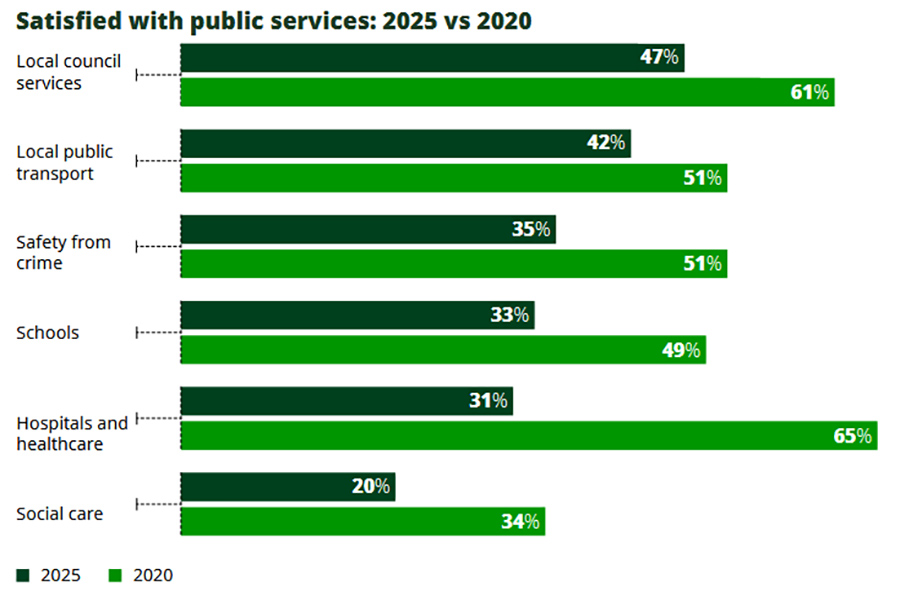
Amid this, faith in public services has fallen too. The researchers contrasted feelings around the public sector in 2020 and 2025, and found a marked fall across every facet in the last five years.
Worst of these declines was the health system – with 65% saying they were satisfied with hospitals and healthcare in 2020, when a global pandemic had stretched it to breaking point. In 2025, however, following an era of restructuring, digitalisation and delivering of ‘efficiencies’ (during which the NHS has remained chronically understaffed), only 31% are now satisfied with the service. Local council services and public transport also saw notable declines from what had been a net-positive position in 2020 – as austerity cuts have continued to decimate them, along with schools, where satisfaction fell from 49% to 33%.
Source: Deloitte
After more than three years of sustained hype, the survey showed that perhaps unsurprisingly, many people saw AI as a way to reverse this process. A 33% portion of respondents said the technology could be used in the public sector to ‘analyse more information’, while the same number said it could lead to ‘less admin’, and 26% said it could ‘reduce costs’.
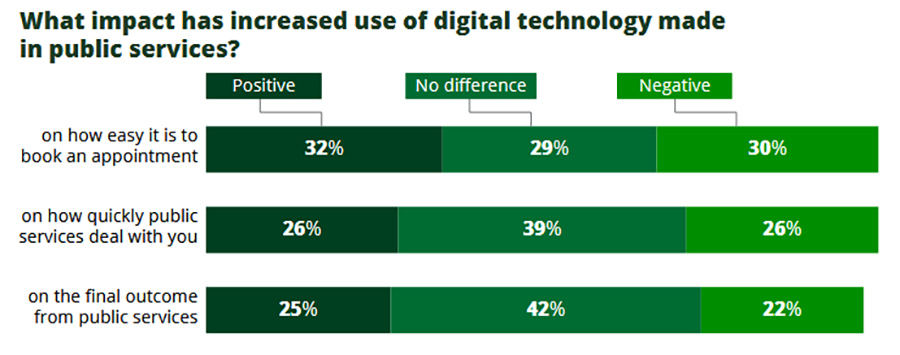
However, even here, people were far more pessimistic than optimistic, with risks more often cited than benefits. For example, half said that reduced human contact, and potential job losses were key risks associated with the technology – while 47% feared a ‘loss of human oversight’ that could make services even more opaque and inaccessible. This may have been driven by previous experience with government deployment of digital technology: in terms of booking appointments, the speed of being dealt with by public services, or the outcome of that process, no more than a third of respondents ever said digital technology had actually improved public services.
Rachel Charlton, government and public services lead partner at Deloitte, said, “AI looks set to play its part in the future of public services. This poll illustrates how the public needs reassurance that AI will not replace the humanity at the heart of their services, but free up time for frontline workers to do more of what they do best – support the public.”
Source link
#Government #lean #restore #public #trust





