

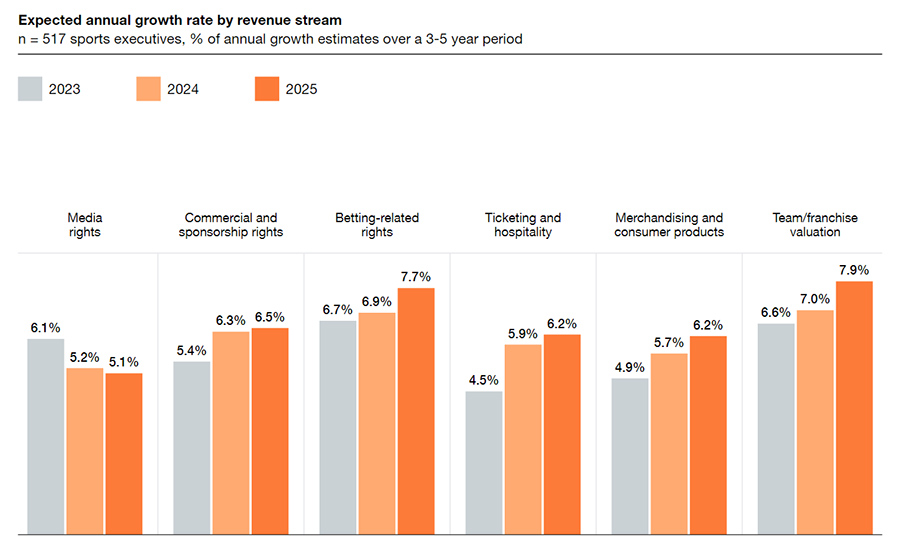
The historic dependence on media rights to propel business growth in professional sports may be drawing to an end, according to a new report. Research from PwC has shown that media rights revenue growth is slowing – against higher than expected growth across all other revenue streams.



PwC’s ninth edition of its Global Sport Survey draws on responses from over 500 senior sports executives globally and 7,250 fans. And while it still predicts healthy growth for the international sports space, the 7.4% (up from 7%) yearly expansion anticipated for the next three-to-five year period is not the stratospheric number many organisations would be hoping for.
According to PwC, growth in sporting revenues is being tempered by pressure on media markets – showing that institutions need to act fast to diversify their revenues, and build long-term sustainability in their organisations. This is especially the case in the most ‘mature’ markets, where saturation of sports in the media is already high. So, while Asia expects to see growth of 9.4%, Europe is forecast to see revenue expansion drop to 6.7%.
Source: PwC
Illustrating how markets are preparing for this ‘sustainable’ future already, increasing relaxation around gambling regulations in the US has helped the otherwise mature market to buck this trend, with growth at above 8%. And across the board, PwC finds this is now the second-biggest driver of growth cited by sports executives – with betting-related rights having boomed from growth of 6.7% in 2023, to 7.7% in 2025. Team or franchise valuation is the only larger driver of growth – with playing the markets now a 7.9% growth driver.
In comparison, media rights have seen growth plateau since 2023. And while it is still not in the negative, seeing the rate of expansion in that line of income fall from 6.1% to 5.1% is a worrying trend, considering the importance many elite sport balance sheets now place on that revenue source – particularly in professional football.
Evolving priorities
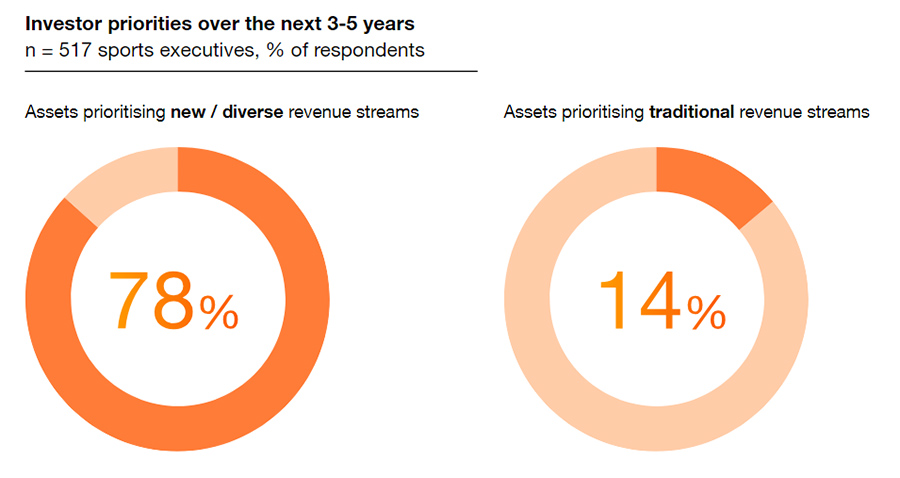
Tom Karkeek, director in PwC’s sports practice, commented, “We’re seeing a clear evolution in sports investment priorities. Capital is flowing toward properties with multiple monetisation levers, whether that’s year round competition formats, strong IP control, or the ability to build digital first fan ecosystems. As the market becomes more competitive, investors who take a longer term view and back models that blend innovation with operational discipline will be best positioned to unlock sustainable value.”
Source: PwC
As a result, while rights ownership remains important for institutional investors, with more than 38% saying it remains a priority in the next three to five years, the reliance on media rights alone is “no longer viable” according to PwC. To that end, four-in-five investors now favour assets offering multiple revenue levers; from sponsorship and hospitality to women’s sport, endurance formats and creator-led competitions, alongside technology-driven adjacencies such as analytics, gaming and content studios.
This in part reflects a long-held assertion that younger generations are falling out of love with traditional sports, or ‘legacy’ broadcasting. PwC maintains this line here, citing a “generational divide in sports media consumption”, where “younger fans consume sports through a more fragmented mix of platforms, while older fans remain concentrated in traditional channels.” As sporting businesses need to attract younger consumers to futureproof their bottom-lines, the argument goes that “social media highlights are favoured by 18 to 34-year-olds, with meaningful engagement in creator-led content and interactive formats” – so “recognising that fan habits are diverging faster than ever, rights holder success will increasingly depend on a multi-platform that balances premium rights with accessibility and reach.”
This is contrary to a recent Altman Solon study, which found younger consumers are by far the most willing to pay to view live matches. More likely, in fact, than ‘bitesize’ highlight content that is supposedly tailormade for their perceived shortening attention spans. The elephant in the room remains the cost of doing any of this. As highlights remain largely free to access – via YouTube or national broadcasters – they might appear more popular to consumers out of necessity, especially amid continued pressure on the cost of living. Trying to monetise these elements might be counter intuitive – in the sense they further price out consumers who already find it difficult to afford access to the hyper-inflated tickets of a matchday experience.
Source link
#Global #sports #sector #set #measured #growth #media #rights #plateau