



While companies struggle to overturn a long-term productivity gap in the UK, they may be overlooking office noise levels in their plans. A new study from Oscar Acoustics shows that employees lose more than three working weeks per year to distracting, noisy office environments.


The return to the office after the pandemic has increasingly been demanded by bosses looking to ramp up productivity. But even as a number of prominent cases roll out policies to restrict home working, the UK’s long period of productivity stagnation shows no signs of ending.
Returning to the office comes with a host of its own distractions, which new research suggests could be eating into any boost leaders expect to see, with the end of remote working. According to a study by architectural acoustics expert Oscar Acoustics, staff lose on average 26 minutes of productive time daily, thanks to noise in the workplace.
That amounts to more than three working weeks every year. And on top of that, 44% of employees told the firm that they believed the quantity and quality of their output were hampered every month, by offices being too loud.
Ben Hancock, managing director at Oscar Acoustics, said, “You can’t see it, but you can feel it. Acoustic comfort isn’t a nice-to-have; it’s as fundamental as lighting or ventilation. We’re seeing employees vote with their feet, choosing to work from home or leave their jobs because their workspaces are too loud.”
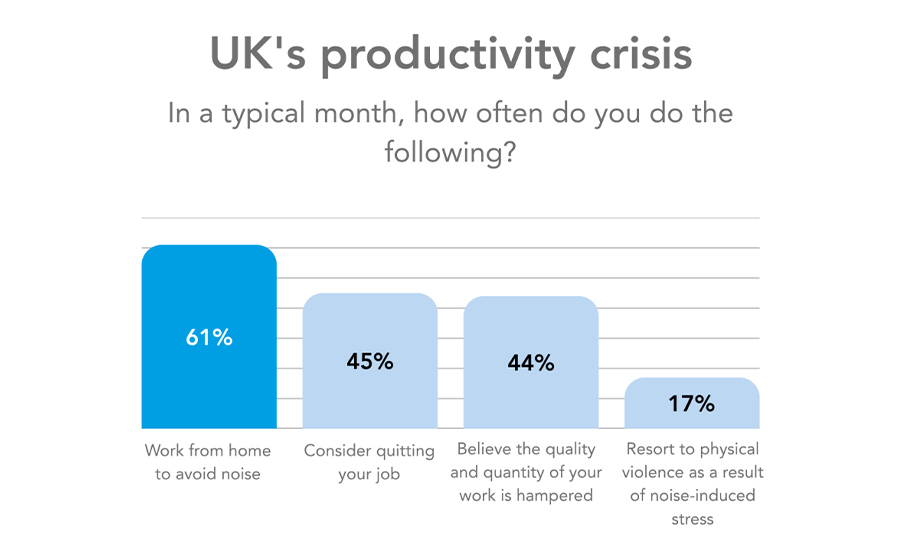
The firm also found that 54% of 2,000 workers polled in the UK said their office is noisy, while just a third said their bosses take workplace noise issues seriously. These poor acoustic environments directly impact the health, comfort and engagement of 30% of the UK population who are noise sensitive, including neurodivergent individuals and those with hearing or visual challenges – aspects of the talent pool which businesses say they have made efforts to include in recent years.
With remote working still an established alternative, 61% of people stay home specifically to concentrate, even beyond their scheduled hybrid days. Despite this, employers are falling behind, with only 8% of companies having installed any acoustic treatment in the last two years, while 85% haven’t even assessed their acoustic environment.
Hancock added, “The lack of consideration for noise levels is impacting British businesses; their staff are losing time and delivering lower-quality work, all because acoustic design is an afterthought. Offices need to be designed for the comfort of the end user rather than just focusing on aesthetics. Having appropriate lighting is considered a baseline requirement for work. Spaces designed for concentration should be too. The solution exists, yet bosses need to start treating sound as seriously as any other aspect of workplace design.”
Source link
#staff #feel #office #noise #impacts #monthly #productivity





