



Proudfoot has been on the shop floor for 80 years – and while much has changed in that time, some key points remain consistent. Looking back on its eight decades consulting across the manufacturing sector, the firm has distilled six best practices for manufacturing companies that still hold true.



Founded in 1946, Proudfoot is a consulting firm which specialises in supporting clients across the manufacturing, mining, chemicals and resource-extraction space. Across those 80 years, the firm has worked to accelerate transformation, and boost return on investment for companies around the world – bearing witness to some of the most important shifts in manufacturing over the last century in the process.
But in yet another era of rapid change, where proponents of AI promise a second industrial revolution, it is also important to remember that technology is not everything. As Proudfoot notes in its latest six-point paper, the operational set-ups that perform best are not the ones with the best equipment, “they are the ones with the best management discipline.” In keeping with this, the firm has established a list of central tenets for top performance in manufacturing – which are as relevant now as they were 80 years ago.
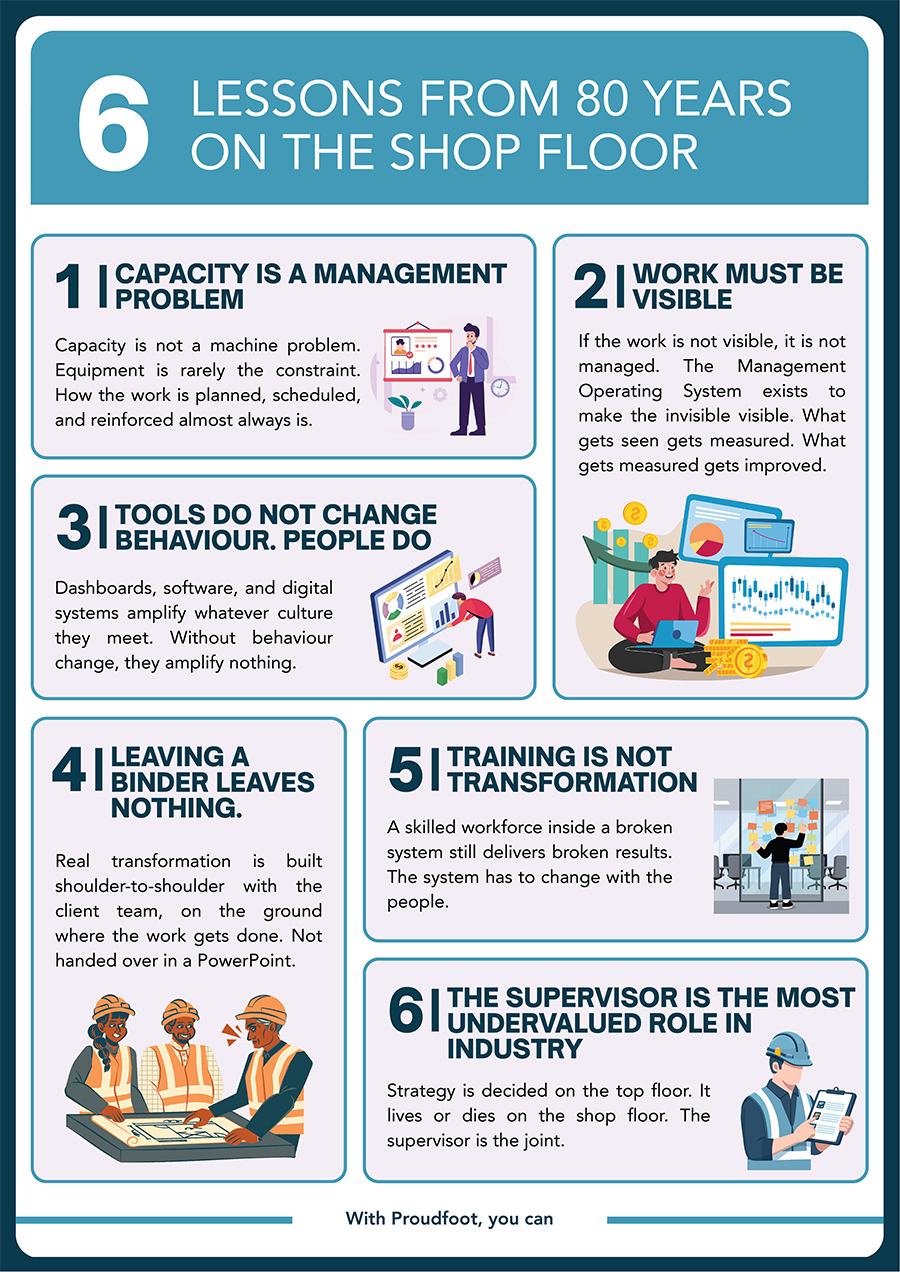
1. Capacity is a management issue
“Capacity is not a maching problem”, Proudfoot maintains. Even as many organisations in every sector rush to replace junior roles with automated processes, and so ‘build capacity’, firms may not enjoy the results they hope for without paying attention to their wider organisational needs.
“Equipment is rarely the constraint,” the experts from Proudfoot add. “How the work is planned, scheduled, and reinforced almost always is.”
2. Work must be visible
The firm follows this up by warning that if work is not visible, “it is not managed.” With organisations still struggling to get the most from transformations – not just in AI applications, but also in chasing net zero and sustainability targets – failing to adequately examine what a firm is actually doing in the first place is often a major issue.
Proudfoot’s consultants noted, “The management operating system exists to make the invisible visible. What gets seen gets measured. What gets measured gets improved.”
3. Tools do not change behaviour
Again, companies can be over-dependent on technological change making all the difference. But as the majority of failed transformations show, a lack of effort to ensure that corporate culture and business models gel throughout an organisation can prove a fatal error.
“Dashboards, software, and digital systems amplify whatever culture they meet,” say the experts. “Without behaviour change, they amplify nothing.”
4. Leaving a binder leaves nothing
One of the things which has changed arguably as much as manufacturing in the last 80 years, is the consulting industry. Having initially grown from small, specialised firms communicating specific skills across a particular industry, the field has increasingly been dominated by generalists – leading to the rise of the infamous stereoptype of the ‘PowerPoint consultant’, selling a one-size-fits-all list of advice without much practical application, and little direct contact with a company outside of the boardroom.
Proudfoot warns, “Real transformation is built shoulder-to-shoulder with the client team, on the ground where the work gets done. Not handed over in a PowerPoint.”
5. Training is not transformation
While companies must work with their staff to evolve culture in line with an organisational transformation, that does not mean they can take their eye off the ball elsewhere. It is also down to leaders to build an environment where their skilled workers are empowered to do their jobs properly in the first place.
According to Proudfoot, “A skilled workforce inside a broken system still delivers broken results. The system has to change with the people.”
6. The supervisor is the most undervalued role in industry
Finally, Proudfoot’s specialists return to remind manufacturing bosses – and those in other industries – to remember that however intricately designed their plans may be, they have to acknowledge the material impacts they have. If a company’s staff are neglected in a proposed transformation, it seldom ends well.
“Strategy is decided on the top floor,” Proudfoot concludes. “It lives or dies on the shop floor. The supervisor is the joint.”
Source link
#technology #manufacturers #succeed