Two years ago, Ekta* found herself sitting at the dining table of her Gurugram home one evening, on a call with a representative from the Kiran Patient Access Program at 6:45 pm. She spoke for over an hour, she says, because she was afraid to hang up. She needed an OTP without which her mother-in-law could not receive her next dose of Keytruda, the blockbuster immunotherapy cancer drug, at AIIMS, Delhi, the following morning.
For 63-year-old Ajit*, first diagnosed with kidney cancer in 2017, the path to Keytruda was slightly less difficult but only because he had the means to purchase a cancer insurance policy. “I remember when I got a hernia at one of the stitches from my kidney removal surgery. My daughter was to get married in a few months but the doctors asked me to hold the wedding earlier. They were not sure I would survive,” he said. He has now been on Keytruda for over a year.


The stories of Ekta and Ajit illustrate the challenges surrounding access to Keytruda. An investigation by The Indian Express, in association with The International Consortium of Investigative Journalists (ICIJ), has found that accessing Keytruda in India, even through the company’s own patient assistance scheme, is beset with financial, logistical and regulatory barriers that put the drug out of reach for the overwhelming majority of patients who need it.
On Monday, The Indian Express reported on how the access squeeze has led to a burgeoning multi-city black market in Keytruda.
Keytruda is the brand name of Pembrolizumab, which is manufactured and sold by pharmaceutical giant Merck & Co (MSD), and is a type of immunotherapy that has shown survival benefit for several cancers. Globally approved for scores of cancers, the company’s patient access programme in India supports it for 10 types of cancer, including specific forms of lung cancer, head and neck cancer, cervical cancer, renal cancer and melanoma.
Its effectiveness has made it the world’s best-selling drug, with sales surging to USD 29.5 billion in 2024, accounting for nearly half of Merck’s revenue. Yet in India, it remains inaccessible to most patients who need it.
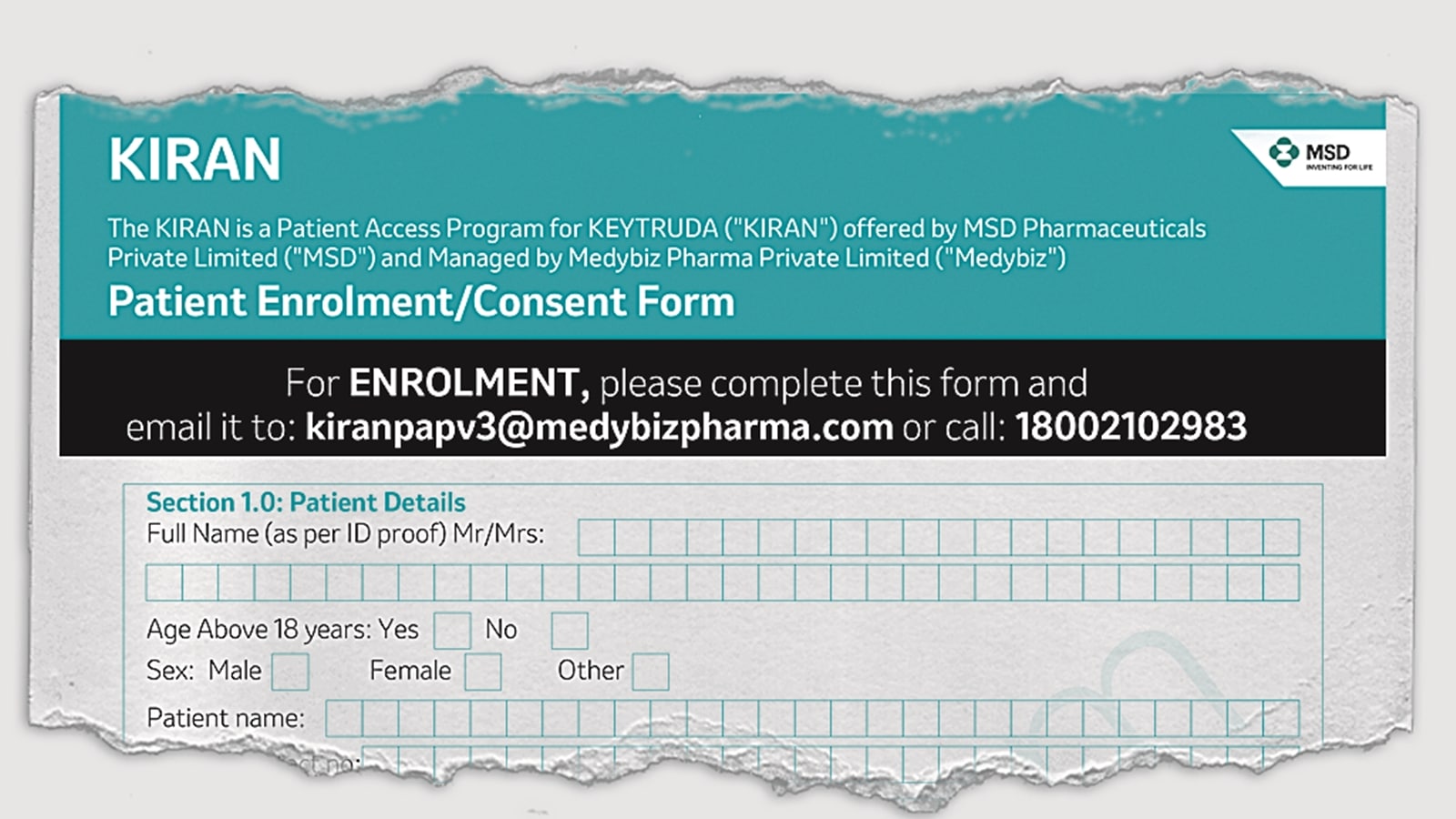 Registration form for Keytruda’s Kiran Patient Access Program.
The process: ‘It was a pain’
Story continues below this ad
The barrier begins with the process itself. Without the Kiran Patient Access Programme, the market price of the drug exceeds Rs 3 lakh for the 200 mg recommended per infusion. The programme provides one free 100 mg vial alongside one that the patient purchases, for the first five infusions, after which patients can access 25 more vials for free. But to qualify, patients must first purchase at least five 100 mg vials, at a cost of just under Rs 10 lakh, up front. If they need more, they have to re-enrol and pay around Rs 10 lakh again.
For Ekta’s family, managing that sum required a combination of corporate insurance coverage through her sister-in-law’s employer and out-of-pocket contributions from her husband and brother-in-law. For Ajit, it was his specialised insurance plan that paid the Rs 10 lakh for the initial doses before he could access the free doses through the programme.
Once inside the programme, the process does not get easier. For each dose, the family had to email an infusion form along with a signed and stamped OPD card carrying the doctor’s prescription. “The programme would get back many times saying that the sign was not there, or the stamp was not there. Then we would have to go back to AIIMS to get it,” said Ekta.
A delivery agent would then verify all documents against what had been emailed in. “Between the two visits to get the infusion, if we had to take her to the hospital for some complication or side effect and the doctor wrote anything on the card, the agent would say it does not match the one that had been mailed in,” she said.
Story continues below this ad
The programme also required one registered caregiver to be present at each infusion to collect the drug, which meant Ekta’s husband had to take a day off for every infusion cycle.
Her mother-in-law needed a dose every three weeks, within a three-day window as the drug requires. Missing an appointment meant losing the AIIMS appointment — and getting another bed within the same three days was, Ekta said, near impossible. “The process was a pain, and if there were any other way to get the drug, most people would not go through this process. Even then, it is difficult for most because it requires one person to dedicatedly be on it,” she said.
The barriers: ‘Most patients drop out’
Beyond the process, The Indian Express investigation identified four structural barriers that limit access to Keytruda in India.
First, information about the programme is limited. The only source of information available to patients is their physician. A Delhi-based oncologist said this creates openings for exploitation: “There are people who promise to provide the drug to desperate patients at a much lower cost. These drugs would usually be counterfeit… there is no way of providing the drugs for cheaper than what is available through the patient access programme.”
Story continues below this ad
Second, the financial threshold to enter the programme is too high for most patients. Even with the programme, the Rs 10 lakh required for the initial doses is prohibitive. The programme also excludes patients who earn more than Rs 25 lakh per year or have a sum-insured above Rs 25 lakh. “Any patient who earns more than Rs 25 lakh per year or has a sum-insured over Rs 25 lakh is not eligible for the programme. These days, there are health insurances available for crores of rupees, some specifically meant for cancer treatment. But, the high sum insured can be a bane for the patients,” the oncologist in Delhi said.
In several cases, doctors said, registrations are done in the name of lower-earning family members or another coverage with lower sum-insured is obtained for disclosure to work around the exclusion. “Even if a person earns Rs 25 lakh a year, how can they afford a drug that costs nearly Rs 4 lakh per infusion every three weeks?” the oncologist said.
According to official estimates, only 20% of Indians are covered through social health insurance schemes or privately purchased insurance, most of which does not cover expensive treatments such as immunotherapy. Among the poorest, about 50% are covered under the Ayushman Bharat scheme and its extensions, but with benefits of up to Rs 5 or 10 lakh, it does not cover such immunotherapies.
Dr Hemant Malhotra, a medical oncologist based in Jaipur, described the conversations he is forced to have with patients: “We have to discuss the best treatments available, but these conversations can be very difficult. We have to tell them up front what it will cost and whether their insurance can cover some of it. Most patients drop out at this stage.”
Story continues below this ad
Third, even those who qualify often cannot access the programme effectively. Dr Atul Batra, additional professor of medical oncology at AIIMS, said that in breast cancer, which is his area of specialisation, annual incidence is around 2 lakh patients. “Of these, around 60,000 with triple negative breast cancer would benefit from pembrolizumab. Only around 5% are able to access it,” he said. Those who do, access it through government programmes like CGHS and ECHS, PM relief fund grants, or similar schemes. “Very few are able to pay out-of-pocket or through an insurance provider for the initial doses to get on to the Patient Access Programme,” he said.
A 2021 real-world study by Tata Memorial Hospital found only 1.61% of the people who required immunotherapy could actually get it, with financial constraints being the most common reason. Across all cancer types for which Keytruda has been approved, access is likely below 2%.
Fourth, the drug can only be prescribed through the Kiran programme by registered medical oncologists or haematologists. Dr Tarun Durga, senior medical oncologist with the Medanta Centre in Delhi, said: “A medical oncologist or a haematologist would have to send in their details, such as their medical council registration number, to the programme the first time they prescribe the drug through it. Their details get recorded with the programme and they have to sign an infusion sheet for every patient they prescribe the drug, for every cycle.”
Radiation oncologists and surgical oncologists are not authorised to prescribe the drug through the programme. A 2018 study by an Indian researcher at University of Kentucky estimated that there were around 1,500 oncologists, including radiation oncologists, in the country — each treating 677 new patients annually. In smaller cities and rural India, access to a registered medical oncologist or haematologist is scarce.
Story continues below this ad
An additional regulatory delay compounds the problem. Dr Batra said there is usually a gap of several months to a few years between the US FDA approving a therapy for a given indication and India’s Central Drugs Standards Control Organisation doing so. During this period, patients for those indications cannot access the therapy through the patient access programme.
Merck & Co (MSD) did not respond to a request for comment from The Indian Express for comment on the process that patients go through to access Keytruda.
(* Names changed to protect the identity of patients)
OTPs, FORMS, ONSITE CHECKS: THE ACCESS PROTOCOL
Registration form for Keytruda’s Kiran Patient Access Program.
* Keytruda is approved in India for ten cancer types, but must be prescribed by a medical oncologist or haematologist — specialists who are largely concentrated in urban centres. The prescribing doctor must be registered with the company, submitting their medical council credentials. The programme also excludes patients who earn more than Rs 25 lakh per year or have a sum-insured above Rs 25 lakh.
* Once prescribed, patients contact the Kiran programme’s helpline to register, submitting treatment history documents. A family member must also enrol as a registered caregiver, using ID proof such as Aadhaar, and is responsible for collecting each dose from the company representative.
Story continues below this ad
* For every infusion, the doctor fills out a form, and the patient emails their documents and the form to a designated ID. If approved, the patient receives an OTP the day before infusion, which must be shared with the drug delivery person, who also physically verifies all documents onsite. Any mismatch between online and offline records can delay treatment.
* Each vial carries a unique code, logged against the patient’s details. Hospitals have to ensure that the patients receive the dose earmarked for them. The programme applies strictly to regulator-approved conditions and only when the therapy is prescribed at the recommended flat dose of 200mg.
Source link
#Painful #paperwork #lakh #upfront #Indias #cancer #patients #locked #bestselling #drug