

There was a time when nightfall meant relief. After the blaze of a long summer day, the hours after sunset carried the promise of a cool breeze through an open window, the temperature dropping enough to pull out a light blanket, sleep coming easy. That time, for much of the world, is quietly disappearing.Across continents and climates, nights are getting warmer, and they are doing so faster than our days. While record daytime temperatures dominate headlines and heatwave warnings flood our phones, a subtler, arguably more consequential shift is happening in the dark. Minimum temperatures which is the lowest point a thermometer reaches in a 24-hour cycle, almost always in the dead of night, are climbing at a rate that is outpacing daytime warming in many parts of the world. Scientists have been watching this asymmetry with growing unease.The consequences are not abstract. Farmers depend on cool nights to allow their crops to recover from daytime heat stress. Ecosystems run on temperature rhythms that have been calibrated over millennia.
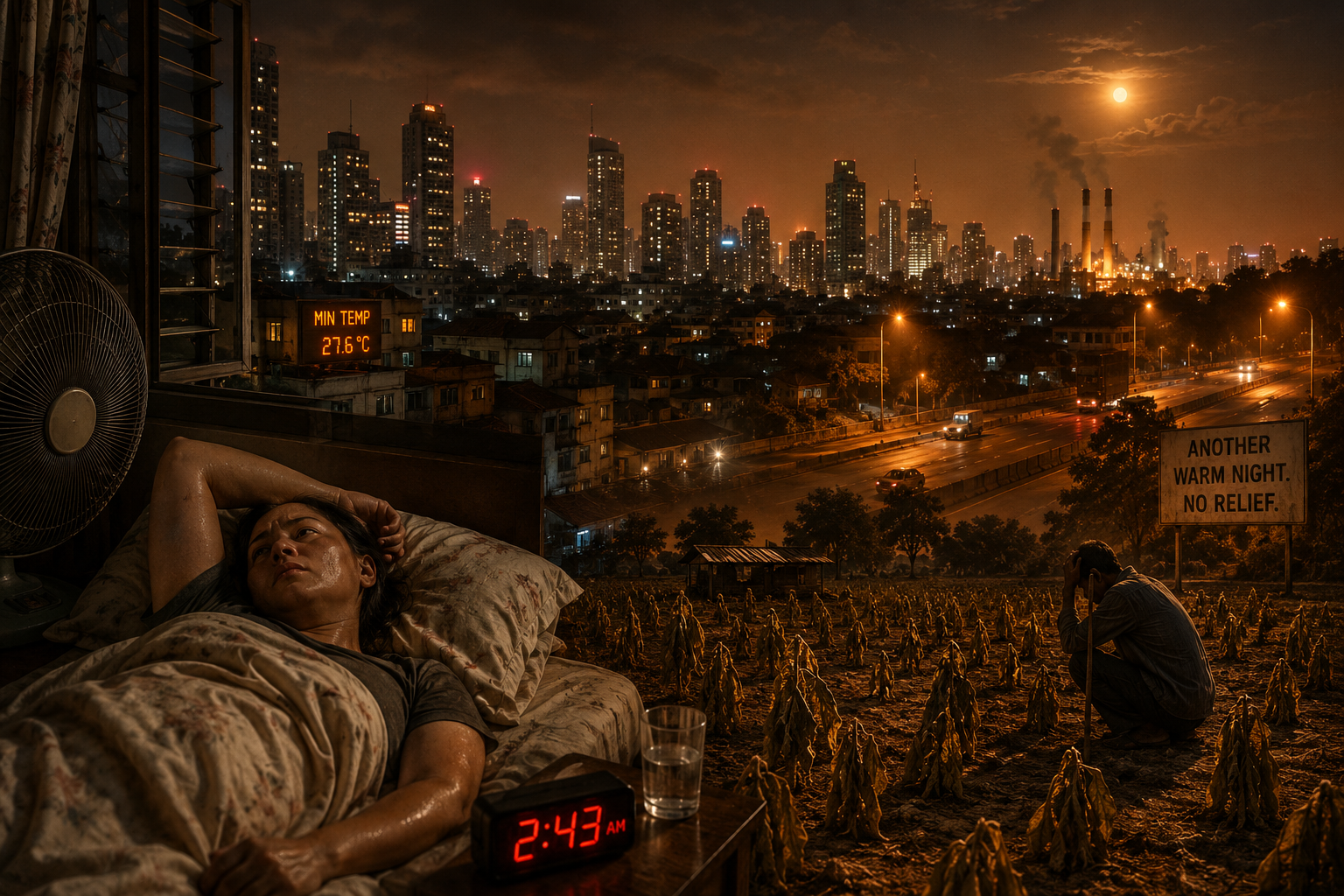



The human body uses the nightly dip in temperature as a biological cue, to repair cells, consolidate memory, regulate hormones, and prepare for the next day. When that dip no longer comes, everything from crop yields to cardiac health begins to fray at the edges.The reasons behind warming nights are layered and multiple, a convergence of greenhouse gas accumulation, urban expansion, shifting cloud patterns, and a planet that has simply absorbed more heat than it can shed. Each factor feeds the others in ways that are still being mapped by researchers.
The Urban heat island effect: How cities trap the day’s warmth
Step outside in any major city at midnight in July, and you will feel it, a thick, lingering warmth that has no business being there. The sun set hours ago, yet the streets radiate heat as though the day never quite ended. This is the urban heat island effect, and it is one of the most significant, and most overlooked, drivers of warming nights.The culprit is hiding in plain sight: the city itself.Concrete, asphalt, brick, and steel are the primary building blocks of modern urban life, and they are remarkably efficient heat traps. Unlike soil or vegetation, which reflect sunlight and release moisture through evaporation, these dense materials behave like thermal sponges. They absorb solar radiation aggressively throughout the day, storing it deep within their mass, and then slowly exhale that stored heat through the night. A sun-baked road or rooftop can remain warm well past midnight, effectively turning entire city blocks into low-grade radiators.Compounding the problem is what cities lack: trees. Green cover provides shade that prevents surfaces from overheating in the first place, and through transpiration, trees release moisture that cools the surrounding air, nature’s own air conditioning. As cities have expanded, green spaces have given way to parking lots, towers, and roads, stripping away this natural buffer and leaving urban temperatures to climb unchecked.Then there is the heat that cities actively generate. Every car engine idling in traffic, every air conditioning unit pushing warm exhaust into the street, every industrial process humming through the night adds thermal energy directly into the urban atmosphere. In dense metropolitan areas, this anthropogenic heat, heat produced by human activity, can measurably raise local temperatures, particularly after dark when the natural cooling process is already being undercut by heat-saturated infrastructure.The result is a city that never truly cools down, and for the millions who live in them, increasingly, neither do they.“Night-time temperatures are rising fastest across already warm and densely populated regions such as South Asia, the Middle East, Africa, and other rapidly urbanising tropical regions. The World Meteorological Organization has confirmed that 2024 was the warmest year on record, at about 1.55°C above pre-industrial levels, with the last decade being the warmest ever. This global trend is clearly visible in India, where CEEW’s analysis shows that over 70% of districts have experienced at least five additional very warm nights each year in the last decade compared to the 1982–2011 baseline,” said Dr Vishwas Chitale, fellow, Council on Energy, Environment and Water (CEEW).
Greenhouse gases and the nocturnal blanket: Why the atmosphere no longer lets heat escape
Think of the atmosphere as a blanket wrapped around the Earth. During the day, sunlight passes through it and warms the ground. At night, the Earth tries to release that heat back into space, but the blanket is getting thicker, and less heat is getting out.
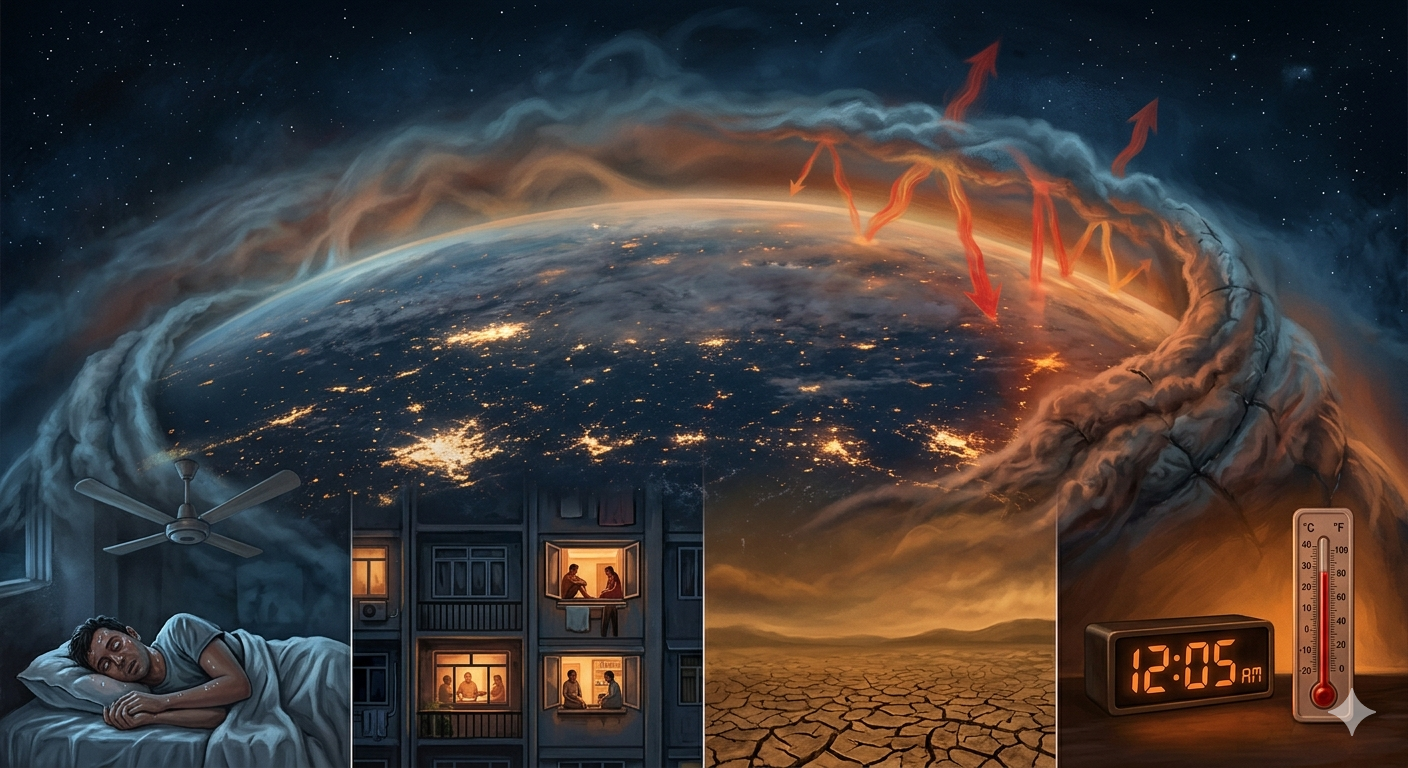
AI generated image
That thickening blanket is made of greenhouse gases, primarily carbon dioxide, methane, and water vapor. These gases absorb the heat rising from the Earth’s surface and push it back downward, warming the lower atmosphere rather than letting it escape into space. The more of these gases there are, the more heat gets trapped, and the warmer our nights become.Since the industrial revolution, CO₂ levels in the atmosphere have climbed from 280 parts per million to over 400, driven largely by the burning of fossil fuels, and methane and nitrous oxide levels have risen sharply too. Every additional molecule of these gases adds another layer to that blanket. This matters most at night. During the day, the sun keeps temperatures up regardless. But after sunset, the Earth relies entirely on releasing heat into the atmosphere to cool down. When greenhouse gases block that release, nighttime temperatures stay elevated long after dark, and the natural cool of night never fully arrives.The numbers bear this out. Over the past 50 years, nighttime temperatures have risen roughly 40 per cent faster than daytime temperatures globally. Across the world’s land surfaces, almost twice as much area has seen stronger warming at night than during the day. It is a quiet but telling shift. The same mechanism heating our days is heating our nights, it just does its most damaging work in the dark, when the planet has no sun to blame and nowhere left to hide the heat.“Heat is no longer just about hotter afternoons—India is now seeing a combined rise in very hot days, very warm nights, and humidity, even in traditionally drier regions, making heat more continuous, more humid, and far harder for both people and infrastructure to cope with,” said Dr Chitale.
Asymmetric warming: Why scientists are more alarmed by night temperatures than day
When climate scientists talk about global warming, the public tends to picture scorching afternoons and record-breaking summer days. But among researchers, it is the night that commands the deeper concern. Not because daytime heat is harmless, it is not, but because what happens after sunset tells a more honest story about the state of the planet.The concept is called asymmetric warming. Days and nights are not heating up at the same rate. Nighttime minimum temperatures are climbing faster than daytime maximums across most of the world’s land surface. It is a distinction that might seem technical, but to climate scientists, it bears a rather significant weight.Minimum temperatures are harder to manipulate. They are less influenced by short-term weather events, urban activity, or seasonal swings. They reflect the baseline, the floor of the climate system, and when that floor keeps rising, it signals something deep and structural is shifting.A hot day can be explained by a passing heatwave, a dry spell, or a burst of summer sun. But a hot night, and then another, and then a decade of them — that points to something the atmosphere is behaving fundamentally differently. The planet is losing less heat after dark. The insulating effect of accumulated greenhouse gases is not a daytime story; it is a round-the-clock one, and the nights are where it shows most clearly.This is why minimum temperature trends have become one of the key indicators climate researchers monitor most closely. They function like a vital sign, a pulse check on the planet’s ability to cool itself. And right now, that pulse is running warm, night after night, in ways that leave less and less room for the natural world to recover before the next day begins.
Source link
#Sleepless #planet #nights #warming #faster #days #India #News #Times #India




